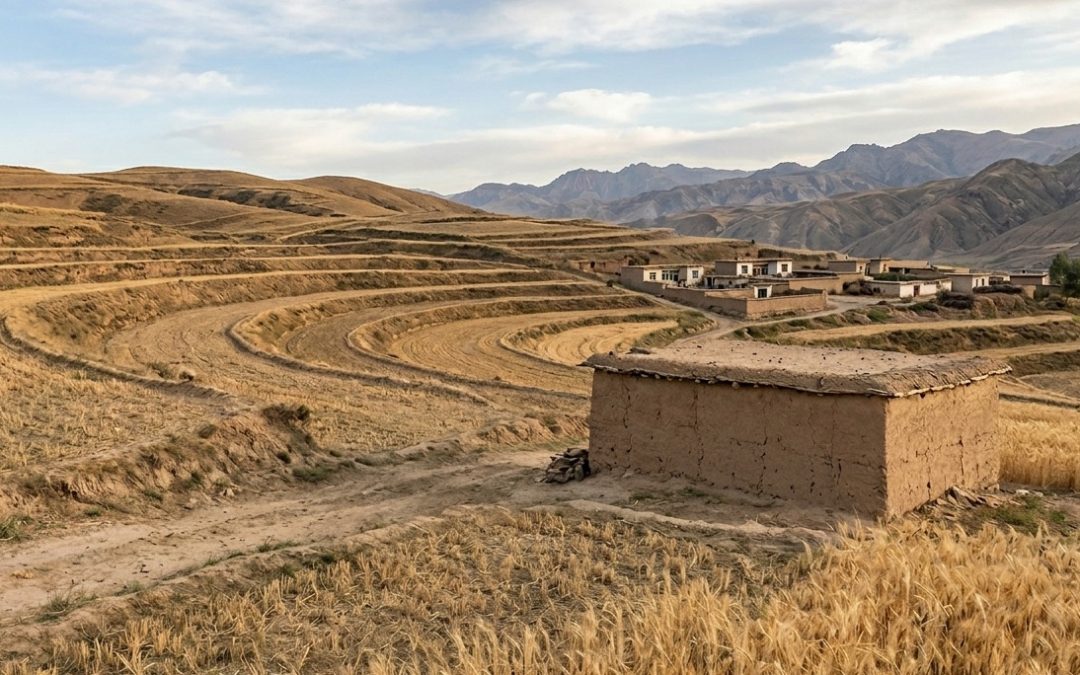
Far from the Arctic ice, on the arid foothills and fertile valleys of the Tibetan Plateau, Tu society forged complex matrimonial alliances at the crossroads of empires. While the Nunatsiarmiut practiced a form of pure survival polygamy, the Tu (Monguor) developed a system where polygamy and its ritual variants served several purposes: clan prestige, land management, and the preservation of the lineage.
I. The Setting: Between Steppe and Monastery
The Tu live primarily in China’s Qinghai Province, occupying a territory that serves as a geographic and cultural transition zone. Historically, they are believed to descend from a fusion of Genghis Khan’s Mongol troops, local Xianbei populations, and Tibetan influences1.
Their economy rests on a complex balance between mountain agriculture (primarily barley and wheat, adapted to high altitudes) and transhumant livestock farming of sheep and yaks. This dual resource—both sedentary and mobile—allowed lineages to settle in fortified villages with rammed-earth walls, while preserving a clan-based social structure inherited from the Mongolian steppes. This hybrid system ensures unique resilience: the food security of harvests combines with the mobile wealth of livestock, allowing the Monguor to maintain autonomy against the climatic pressures of the plateau and the fluctuations of neighboring empires.
Ethno-historical Data
- People: Tu (Monguor / “Mongols of the Gansu-Tibetan Frontier”)
- Geographic Zone: Northwest China (Qinghai Province, Loess Plateau, and Tibetan borders)
- Climate: Arid Mountainous (High altitudes, harsh winters, short dry summers)
- Matrimonial System: Lineage-based Polygyny / Ritual Marriage to Heaven (Bagai-li) (Logic of preserving the family name and land heritage)
- Base Economy: Mountain agriculture and Transhumant livestock (Barley, wheat, sheep, yaks, and horses)
- Status of Women: Guardian of filial piety and grain reserves (Mistress of the household and pivot of the replacement system in the absence of a male heir)
- Ethnoatlas Code: Eb2 (Murdock).
Ethno-historical Data
- People: Tu (Monguor / “Mongols of the Gansu-Tibetan Frontier”)
- Geographic Zone: Northwest China (Qinghai Province, Loess Plateau, and Tibetan borders)
- Climate: Arid Mountainous (High altitudes, harsh winters, short dry summers)
- Matrimonial System: Lineage-based Polygyny / Ritual Marriage to Heaven (Bagai-li) (Logic of preserving the family name and land heritage)
- Base Economy: Mountain agriculture and Transhumant livestock (Barley, wheat, sheep, yaks, and horses)
- Status of Women: Guardian of filial piety and grain reserves (Mistress of the household and pivot of the replacement system in the absence of a male heir)
- Ethnoatlas Code: Eb2 (Murdock).
II. Social Structure: The “Hala” and the Patrilineal System
Tu society is rigorously organized around the Hala (the patrilineal clan). Murdock (Eb2) classifies this society as having strict patrilineal descent and patrilocal residence (where the wife joins the husband’s family).2.
- The Tusi: Historically, the Tu were governed by local chiefs (Tusi) recognized by Chinese imperial dynasties. Among these elites, polygamy served as an instrument of diplomatic power3.
- Clan Solidarity: As with the Nunatsiarmiut, the individual is nothing without their clan. However, in this context, the clan owns the land, and marriage is the primary tool used to prevent the fragmentation of family plots.
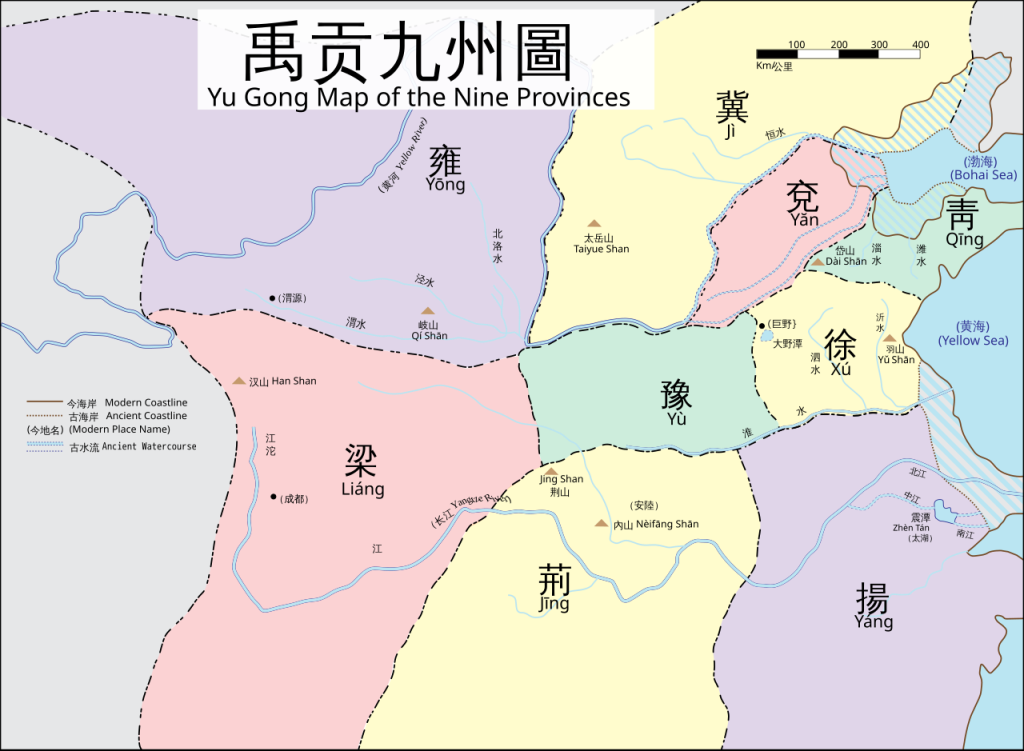
Map Legend: The Nine Provinces according to the “Yu Gong” (禹貢九州圖)
This map offers a historical and conceptual representation of the “Nine Provinces” (Jiuzhou) of ancient China, as described in the Yu Gong (Tribute of Yu) section of the Shujing (Classic of Documents), an ancient Confucian text. It illustrates the territorial boundaries and key geographical features of that era, including:
- The Nine Provinces: Each province is delineated by a distinct color block, labeled with its name in Chinese characters and Pinyin (e.g., Yǒng 雍, Liáng 梁, Xú 徐).
- Historical Comparison: An integrated legend box (bottom left) provides a crucial comparative guide:
- Coastlines: Ancient coastlines (dashed blue lines) are compared with Modern coastlines (brown lines).
- Place Names: Ancient place names (e.g., Qing 青) are compared with Modern names (indicated in parentheses, e.g., (Bohai Sea)).
- Waterways: Ancient rivers (e.g., the Yellow River, the ancient Yangtze) are traced in comparison with their current paths.
- Key Geographical Features: The map identifies sacred mountains (e.g., Tàiyuè Shān 太岳山, Hàn Shān 漢山), seas (Bohai and Yellow Seas), and major river systems.
Context for this article: The westernmost region (near the Liáng and Yǒng provinces), situated on the Loess Plateau adjacent to the Tibetan border, is the historical heartland where the ancestors of the Monguor (Tu) people forged their complex social structures on the periphery of imperial control.
III. Polygamy among the Tu: Prestige and Continuity
It is crucial to note that polygamy among the Tu (Monguor) presents unique characteristics influenced by both Tibetan Buddhism and Confucianism.
1. Elite Polygyny: Among the Tu, polygamy served as a marker of social status. Clan leaders took multiple wives to increase the labor force, guarantee male descendants, and forge strategic alliances.4.
2. A Unique Specificity: The “Marriage to Heaven” (Bagai-li) This is where Tu society becomes truly singular. They practiced a form of “ritual marriage” for women who wished to remain in their paternal home. Once “married to Heaven” (or to the central pillar of the house), the woman could have relationships with multiple partners5. The children born from these unions were fully integrated into the maternal clan, ensuring the household’s continuity even if no son had been born to the family.
IV. Immersion: Hierarchy Beneath the Earthen Roof
In a traditional Tu home, space is sacred. Within a polygamous household, the “Senior Wife” (the first wife) holds the keys to the grain reserves and supervises the labor of the co-wives. Filial piety is the golden rule: the polygamous husband must balance his attentions to maintain the harmony of the Hala6.
Conclusion: The Flexibility of a Rigid System
The study of the Tu (Monguor) reveals a fascinating lesson in social engineering: that of a seemingly inflexible patrilineal system that successfully created “safety valves” to ensure its longevity. Where other societies might collapse for lack of male heirs, the Monguor invented, through the “Marriage to Heaven,” a hybrid structure capable of transforming a biological constraint into an opportunity for clan strengthening.
If Arctic polygamy was a response to resource scarcity, Monguor polygamy is a response to the management of abundance and the sanctification of the lineage. It reminds us that behind every matrimonial rule lies a strategy for territorial survival, proving once again that the family is humanity’s most sophisticated technological tool.
Footnotes
- Schram, L. M. (1954). The Monguors of the Kansu-Tibetan Frontier: Their Origin, History, and Social Organization. Transactions of the American Philosophical Society. [Note: This is the definitive source for understanding the “Sok” (clan) system. Schram details how the Monguor maintained a distinct Mongol identity while operating as a frontier guard for the Chinese Empire, leading to a unique hybrid social hierarchy.] ↩︎
- Murdock, G. P. (1967). Ethnographic Atlas. [Note: Under code Eb2, Murdock classifies the Monguor among the peripheral societies of East Asia. This categorization is vital as it reflects a departure from pure nomadic structures toward a more rigid, land-based patrilineal model influenced by regional administrative systems.] ↩︎
- Hermanns, M. (1948). Die Nomaden von Tibet. [Note: Provides a crucial analysis of the Tusi system—local hereditary headmen. Hermanns explores how these elites used polygyny not just for reproduction, but as a diplomatic tool to cement land rights and military alliances between the central government and the clans.] ↩︎
- Lhamo, Y. (2012). Gender and Marriage among the Tu People. [Note: Essential for understanding the domestic power of the “First Wife.” Lhamo describes the “Hala” as an economic unit where women manage the thermal and caloric survival of the household, much like the Inuit “Nuliaq,” but within a sedentary agricultural context. ↩︎
- Dabaa, S. (2001). The “Marriage to Heaven” in Monguor Society. [Note: A technical study of the “Bagai-li” ritual. Dabaa demonstrates how this practice functions as a socio-legal loophole, allowing a clan without male heirs to retain a daughter’s reproductive labor and keep the resulting offspring within the maternal lineage.] ↩︎
- Lim, E. (2006). Household Dynamics in Qinghai. [Note: Analyzes the spatial and spiritual organization of the Tu home. Lim focuses on the “central pillar” of the house as a sacred site for the “Marriage to Heaven” and the symbolic seat of the ancestors’ authority over the living household.] ↩︎
Frequently Asked Questions (FAQ)
What is the origin of the Tu (Monguor) according to Murdock?
Is the "Marriage to Heaven" (Bagai-li) a form of polygamy?
What religion influences marriage among the Tu?
Social Systems and Realities from Elsewhere
Explore the Diversity of the World’s Foundations

Nunatsiarmiut: The Ethos of Ice and Survival Polygamy

The Engineering of the Union: The Five Universal Logics of Polygamy
Tuareg (Kel Tamasheq): The Sentinels of Matriliny