
The Yakuts of Siberia: The Engineering of Dispersed Polygyny
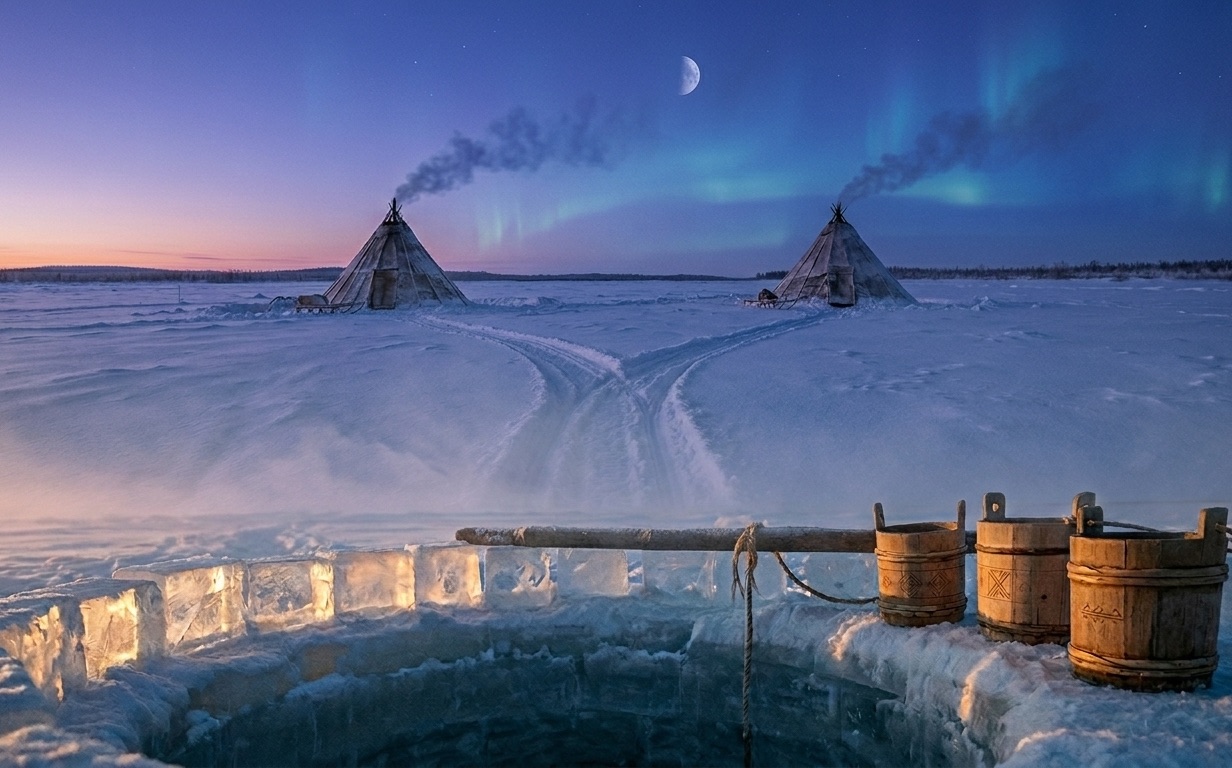
Imagine a land where the air burns the lungs and the ground is as hard as iron. In the Lena River Basin of Eastern Siberia, survival is not a mere concept; it is a war of movement against the frost. The Yakuts did not simply survive this ‘Pole of Cold’; they colonized it by transforming the family structure into a decentralized logistical infrastructure.
Ethno-historical Data
- People: Yakuts (Autonym: Sakha)
- Region: Lena River Basin, Sakha Republic (Siberia)
- Climate:Hyper-continental (Pole of Cold)
- Marital System: Dispersed Polygyny (Multiple households)
- Core Economy: Cattle and horse breeding, hunting, fishing
- Woman’s Status: Autonomous manager of the winter household (Balagan)
- Ethnoatlas Code: Ec2 (Murdock).
Ethno-historical Data
- People: Yakuts (Autonym: Sakha)
- Region: Lena River Basin, Sakha Republic (Siberia)
- Climate:Hyper-continental (Pole of Cold)
- Marital System: Dispersed Polygyny (Multiple households)
- Core Economy: Cattle and horse breeding, hunting, fishing
- Woman’s Status: Autonomous manager of the winter household (Balagan)
- Ethnoatlas Code: Ec2 (Murdock).
The Cold Factory
In the Siberian steppe, the danger is not merely the predator; it is the concentration of risk. For a wealthy horse and cattle breeder (Toyon), keeping 500 head of livestock in a single location is a fatal error: a localized storm or epidemic could annihilate his entire capital overnight.
Yakut social engineering created the ‘Alaas Polygyny‘. Instead of gathering his wives under one roof, the patriarch establishes each wife in a different Alaas (a fertile glade with its own water source), sometimes as far as thirty kilometers apart.
- Each wife acts as a branch manager: She oversees her own herd, her own servants, and her own hay stocks.
- The patriarch becomes a network inspector: He travels from household to household. This is not a polygamous home in the traditional sense; it is a production archipelago. If one Alaas is struck by misfortune, the other four ensure the clan’s survival. Here, the plurality of wives serves as insurance against extinction [1].
Blood Finance: The Kalym as an Investment
Among the Yakuts, one does not simply marry a woman; one acquires a high-value production unit. The Kalym (bride price) is paid in livestock—the local currency.
- The Toyon’s calculation: Investing 50 cows for a second wife is not an expense; it is a capital placement. This wife brings her labor, her skill in transforming milk into koumiss, and, most importantly, she produces new shepherds.
- The logic of conquest: By multiplying unions, the patriarch secures alliances with other clans across hundreds of kilometers. Each new wife acts as a political and economic ‘relay station,’ allowing the clan to circulate goods and information throughout the frozen immensity [2].
The Dismantling: The Freezing of Structures
The fall of the ‘Yakut Fortress’ played out over two centuries. First, the Orthodox Church attempted to break this network by imposing monogamy, failing to understand that removing a wife was equivalent to closing a vital factory.
But it was Soviet collectivization that dealt the final blow. By nationalizing livestock, the State rendered the multi-household management system obsolete. The Toyons were liquidated as ‘Kulaks,’ and the family archipelagos were forced to consolidate into sedentary villages. By shattering dispersed polygyny, the Soviets did not just change social customs; they destroyed the crisis management software that had allowed the Yakuts to rule the permafrost independently [3].
FAQ
Why not simply hire shepherds?
Because in the Yakut social code, only the bond of blood or marriage guarantees the absolute loyalty required to manage thousands of animals in extreme conditions. A wife has a direct stake in the survival of the clan’s capital; an employee can flee when the thermometer drops too low.
Were the co-wives rivals?
Physical distance (isolation in separate alaas) was the best conflict regulator. By not having to share the same kitchen or daily living space, the co-wives maintained a managerial autonomy that limited the domestic friction typically found in harem-style systems [4].
Footnotes
[1] Jochelson, Waldemar (1933). The Yakut. American Museum of Natural History. (The foundational work describing how the structure of dispersed settlements directly corresponded to the number of the leader’s wives).↑
[2] Murdock, George Peter (1967). Ethnographic Atlas. Pittsburgh: University of Pittsburgh Press. (Ethnoatlas Code Ec2: Identifies the Yakuts as a complex pastoral society with high-level polygyny linked to livestock capital management).↑
[3] Balzer, Marjorie Mandelstam (1999). The Tenacity of Ethnicity: A Siberian Saga in Post-Soviet Russia. Princeton University Press. (Analyzes the impact of the collapse of clan and polygamous structures on the economic autonomy of the Sakha against central power).↑
[4] Sieroszewski, Wacław (1896). 12 lat w kraju Jakutów (12 years in the Land of the Yakuts). (The author, a political exile, observed firsthand how the hierarchy between the “great wife” and “lesser wives” functioned as an economic command structure).↑
Social Systems and Realities from Elsewhere
Explore the Diversity of the World’s Foundation
The Monguor (Tu) People: Clan Systems and Matrimonial Dynamics
Discover the social engineering of the Tu (Monguor). From patrilineal clans (Hala) to the unique “Marriage to Heaven,” explore how this High Asian society uses polygamy to guarantee lineage sovereignty.

Nunatsiarmiut: The Ethos of Ice and Survival Polygamy
The matrimonial history of the Nunatsiarmiut offers an inverted mirror of our own social constructions. It teaches us that the family is not a fixed form, but a plastic structure capable of adapting to the most extreme conditions.

The Engineering of the Union: The Five Universal Logics of Polygamy
Explore the 5 universal logics structuring polygamy: survival, demography, production, diplomacy, and legal regulation. A cold, objective analysis of traditional social engineering vs. modern lenses.
Tuareg (Kel Tamasheq): The Sentinels of Matriliny
Forget the romance of the “Blue Man.” Dive into a unique social structure where women own the home and polygamy is a surgical diplomatic weapon. A radical analysis of the Saharan bedrock.