The Sahel is not a shadow zone; it is a space of flow. At the heart of this vast 5,400-kilometer strip that the ancients called Sāḥil (ساحل) — the shore — the Hausa people embody the most sophisticated form of resistance to colonial partitioning. Where European cartographers saw “voids” to be filled with a ruler, Sahelian societies maintained networks. Where the Berlin Conference drew borders, the Mosaic continued to breathe.
To understand the Hausa trajectory is to accept a radical truth: the true sovereignty of the Sahel is not read on official maps, but in the ledgers of Kano’s merchants and the blood pacts between chiefdoms on either side of the demarcation lines.
The Berlin Scar: When Paper Defies the Sand
In 1885, Africa was carved up in the hushed silence of European salons. For the Hausa heartland, it was an amputation. The Sokoto Caliphate, a major political and spiritual entity, found itself severed. The North (modern-day Niger) fell under French administration, while the South (modern-day Nigeria) came under British rule.
Yet, this Niger-Nigeria border is what we call a “paper border.” For a Hausa from Maradi or Katsina, it is not an identity limit, but an economic adjustment variable.
- The Border-Ethnos: The Hausa transformed colonial constraint into opportunity. They inhabit the border, they practice it, and they bypass it. It becomes a lever to play on price differentials, currencies (Naira vs. CFA), and regulations.
- Rejecting the Straight Line: Sahelian sovereignist thought rejects Westphalian rigidity. Hausa identity is reticular: it functions as a network, not within a closed perimeter.
The Ecosystem of Resilience: The Symbiosis of Peoples
The strength of the Hausa lies in their capacity not to be alone. They are the pivot of a gear of solidarities that defies time. This resilience is the product of a functional blending with neighboring ethnic groups.
1. The Hausa-Zarma Duo: The Balance of Power
To the west, the relationship with the Zarma (or Djerma) is fundamental. It is a “marriage of convenience” that structures the modern Nigerien state. While the Zarma have long held the levers of administration and the military, the Hausa have maintained the economic heartbeat. This duality is not a fracture, but a regulatory mechanism: a tacit alternation that ensures stability in an unstable regional environment.
2. The Hausa-Tuareg Pact: Salt and Millet
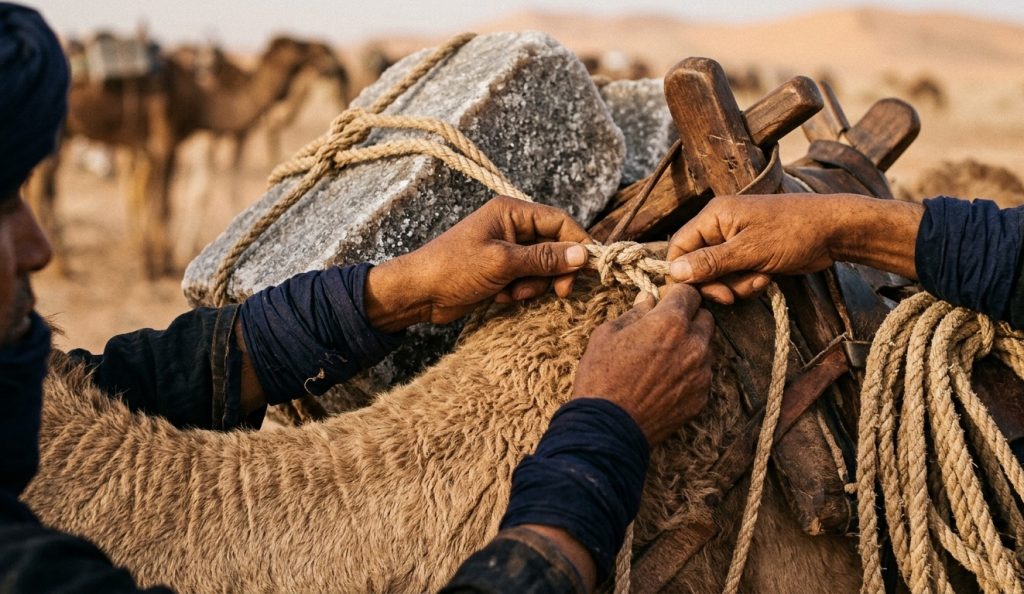
This is where the notion of Lifelines takes on its full meaning. The pastoral Sahel (Tuareg) meets the agricultural Sahel (Hausa). For centuries, these two worlds have exchanged much more than salt and grain. They exchange spaces. During periods of drought, Tuareg herds move down to graze on Hausa crop residues. In return, Hausa merchant networks rely on the protection and desert knowledge of the nomads. This is organic sovereignty: it is built on the need for the other, not on exclusion.
3. The Kanuri Stronghold: Historical Depth
To the east, toward the Lake Chad Basin, the Hausa live alongside the Kanuri, heirs to the Bornu Empire. This zone serves as a historical bulwark against external incursions. Together, they form a cultural bloc whose historical depth makes contemporary attempts at destabilization appear trivial.
Network Technology: Sovereign Informality
The Sahelian economy is often labeled as “informal.” This is a term of contempt used by those who do not understand it. In reality, it is the most real and sovereign economy in existence.
- Language as Infrastructure: Hausa is not merely a mother tongue; it is a commercial operating system. It allows a cattle trader from Chad to negotiate with an importer in Lagos or a shopkeeper in Niamey. It is the invisible cement of regional integration.
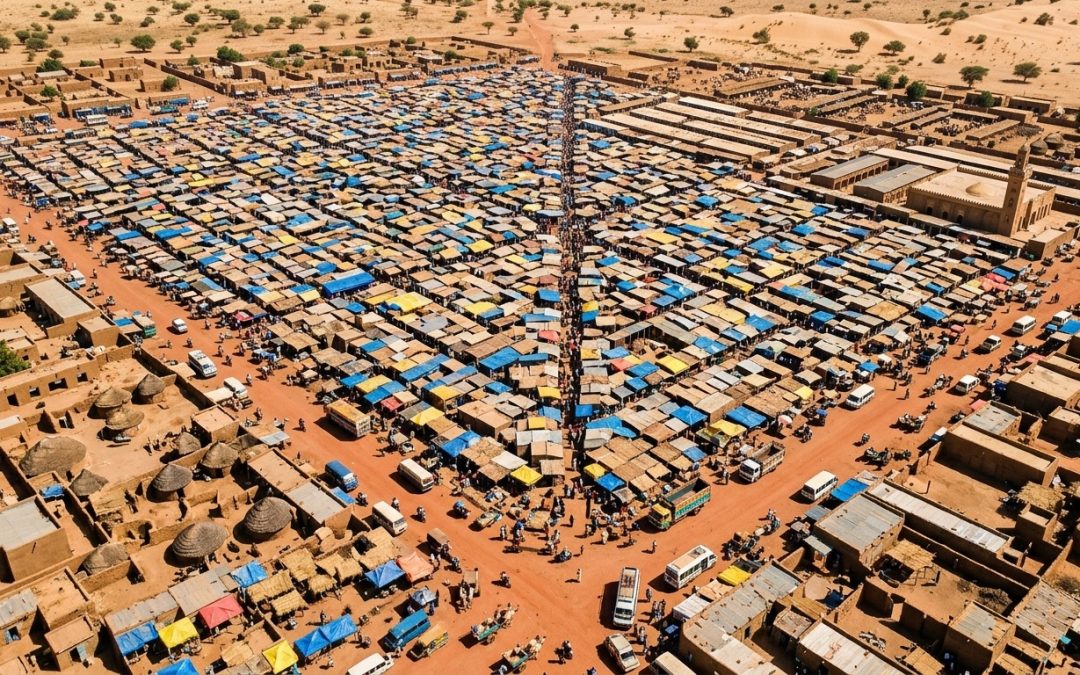
- The Web of Markets: Long before the advent of the Internet, the markets of Kano, Zinder, and Maradi functioned as data hubs. Grain prices, security risks, and political opportunities circulate there at a speed that state administrations cannot match.
- Monetary Independence: The constant shifting between the CFA and the Naira creates a de facto zone of monetary freedom. The Hausa invented a form of “social cryptocurrency”: a credit system based on trust (amana) and reputation, often rendering the traditional banking system secondary.
The World’s Foundation: An Anthropology of Survival
Why does this structure still hold? To understand it, one must dive into what we call The Foundation. The Hausa family is a unit of both production and projection. Polygamy, in this context, is not merely a social fact; it is a deployment strategy. A family may have one foot in Kano for trade, another in Maradi for agriculture, and a third abroad for studies or imports.
This “familial ubiquity” makes the Hausa people elusive to any State attempting to freeze them in place. It is a biopolitics of resilience.
Conclusion: Toward a Sahel of the Peoples
The history of the Hausa and their neighbors teaches us that the Sahel is not a land of scarcity, but a land of surplus—a surplus of bonds. Colonial borders are but paper walls; the Lifelines of the peoples are rivers of life.
For the Sahel to reclaim its full sovereignty, it must not seek to copy the European nation-state model, which is far too narrow for its vastness. It must look at its own mosaic. It must draw inspiration from the Hausa capacity to turn every border into a bridge and every difference into a commercial opportunity.
The sovereignty of tomorrow will not be defended by armies alone, but by the robustness of these invisible networks which, from the Atlantic to the Red Sea, continue to trace the only lines that truly matter: those of life and a shared destiny.
To Go Further:
- Explore our study on the internal dynamics of Sahelian families in our section The World’s Foundation.
- Follow our field reports in our Decipherings.
Editorial Note: This text inaugurates our new category, Lifelines. It lays the groundwork for our vision: a Sahel that is proud, interconnected, and resolutely the master of its own narrative.
Sources of the Real
Below is a selection of foundational works to further explore the themes of Sahelian sovereignty and the trajectories of its peoples.
Geopolitics & Borders
- Camille Lefebvre, Frontières de sable, l’État au Niger (Sand Borders, the State in Niger): A masterful analysis of how the 1885 line was absorbed, diverted, or ignored by the local populations. It remains the definitive reference for understanding the “lived border” on a daily basis.
- Michel Foucher, Frontières d’Afrique : Pour en finir avec les 20 % (African Borders: Ending the 20% Myth): A work that deconstructs the myth of “artificial” borders to show how they have become, over time, strategic and political assets for the peoples themselves.
Hausa History & Civilization
- Mahdi Adamu, The Hausa Factor in West African History: The “Bible” of Hausa cultural expansion. The author demonstrates how this people wove a commercial and linguistic web across West Africa long before the arrival of Europeans.
- Murray Last, The Sokoto Caliphate: The foundational narrative of the region’s pre-colonial political and spiritual order. Essential for understanding the historical legitimacy that persists beneath modern state structures.
Sociology & Resilience Networks
- Emmanuel Grégoire, Les commerçants haoussa du Niger (The Hausa Traders of Niger): A deep dive into the business networks of Maradi. It explains how brotherhoods and mutual trust effectively replace traditional banking systems.
- Kate Meagher, Identity Economics: She deconstructs how ethnic identity becomes a true “invisible economic infrastructure,” often more effective than state regulations for the survival of populations.
- George Peter Murdock, Ethnographic Atlas: The technical tool for dissecting family and matrimonial structures. Indispensable for analyzing the role of kinship in demographic and economic resilience.
Sovereignty & African Thought
Achille Mbembe, Sortir de la grande nuit (Out of the Dark Night): A profound reflection on the decolonization of space and minds. Ideal for theorizing the transition from the nation-state model to a true Sahelian community of destiny.
Felwine Sarr, Afrotopie (Afrotopia): A manifesto for African intellectual sovereignty. The author invites us to draw from the traditions and vital forces of the Sahel to invent a future that is not a mere copy of the West.
More Lifelines…