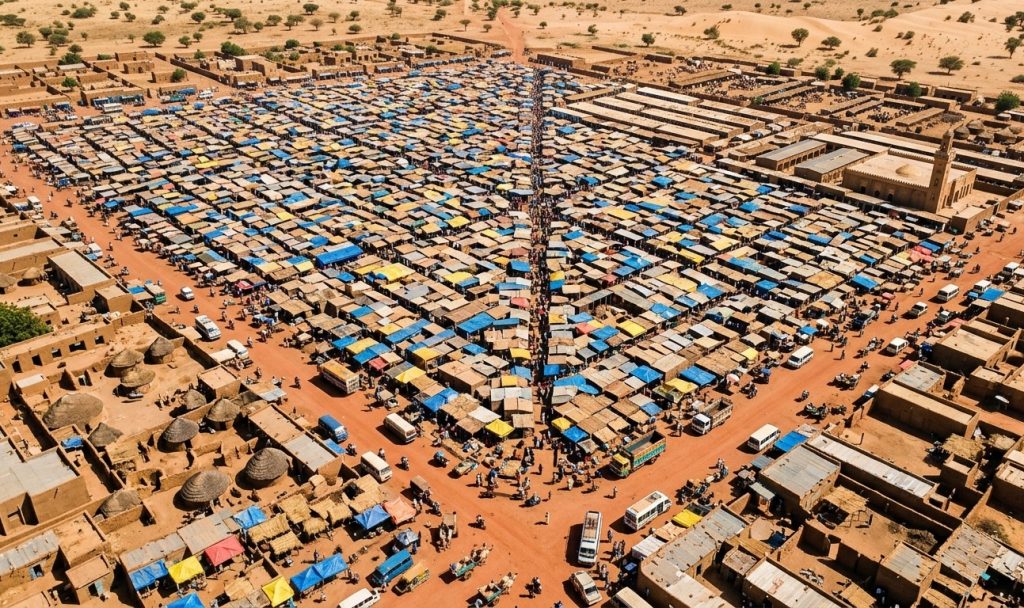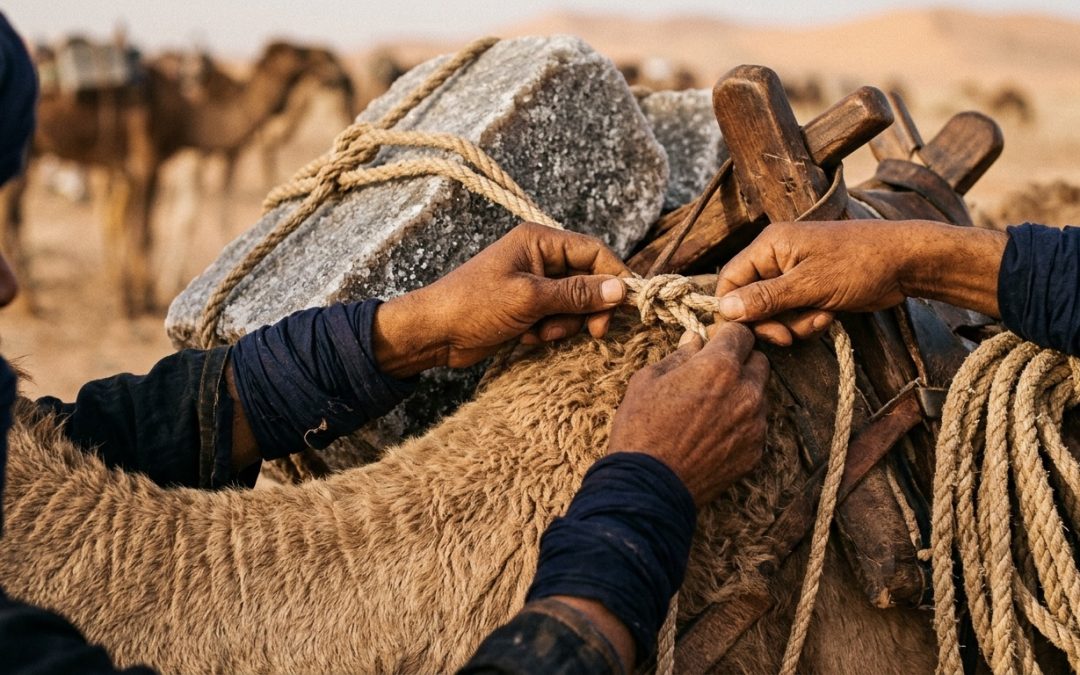
The Sahel is often depicted as a zone of rupture—a vast geographical void separating North Africa from the sub-Saharan savannas. However, through the lens of Radical Objectivity, this space is not a fracture, but a complex nervous system where the Kel Tamasheq act as the neurons. Far from being a nomadic group in decline, the Tuareg constitute the essential “link-people” (peuple-maillon) of the continent. By mastering the interstices that nation-states desperately attempt to freeze, they ensure the vital connection between Mediterranean worlds and the economic hubs of the South. This article explores the trajectory of a people for whom the border is not a limit, but an infrastructure of sovereignty and motiont1.
I: Route Engineering — Mastering the Interstices
The Sahel is not a void; it is a complex architecture of points and lines. While sedentary societies have historically consolidated the points (city-states, trading posts, granaries), the Kel Tamasheq designed the lines. In Saharan ontology, space is not a surface to be owned, but a distance to be resolved. For this link-people, sovereignty is expressed not through enclosure, but through the capacity to connect what would otherwise remain fragmented.
The Well as a Logistical Hub
In the external imagination, a well is a symbol of elementary survival. In the Sahelian reality, it functions as a network node. Tuareg engineering consists not only of locating water but of regulating passage. Every water point in the Azawagh or the Aïr acts as a data exchange center: here, pasture conditions are analyzed, price fluctuations in the south are monitored, and the movements of neighboring groups are tracked.
This mastery makes the Tuareg the managers of an invisible yet rigorous infrastructure. Where modern administrations see a “gray zone” escaping their control, local populations see an ordered grid where the 1885 partition lines have been absorbed, bypassed, or purely ignored in favor of the “lived border” 2. Their detachment from formal politics highlights a profound truth: a line drawn on a map cannot interrupt a trajectory dictated by vital cycles. Far from being obstacles, these borders have become strategic resources that the Tuareg link knows how to activate or circumvent according to the needs of the flow 3.
The Guide: The Continent’s Navigation System
Before being a poetic figure, the Tuareg guide is a technical expert. The ability to interpret land relief, sand texture, and celestial positions constitutes the continent’s primary navigation system. This expertise makes them indispensable to any form of transversality. Historically, no political structure could project influence into arid zones without relying on this human link, capable of maintaining political and spiritual order where the State ends4.
Today, this function has mutated without losing its substance. The convoy driver or the cross-border trader uses the same mental mapping as their ancestors. They are the guidance systems of an economy that refuses to stop at customs posts, ensuring territorial continuity where administrations perceive only ruptures.
Chapter II: The Commercial Link — The Economy of Transversality
If we observe the Sahel as a precision mechanism, the Tuareg is its transmission belt. Their function does not stop at navigation; it is crystallized in the transaction. The Sahelian economy is not a mere juxtaposition of markets, but a system of commercial and linguistic networks woven long before the arrival of colonial powers5.
The Salt and Millet Pact
The heart of commercial resilience lies in a millenary symbiosis. The Tuareg transport salt from northern mines—the “white gold” essential for livestock and food preservation—to exchange it for the cereal surpluses of southern agricultural zones. This is more than mere barter; it is a mutual survival contract. In times of crisis, this ability to move resources from one ecosystem to another transforms the Tuareg into a guarantor of regional food security.
By inhabiting the border, they exploit the differentials in prices and currencies, turning every administrative barrier into a growth lever. This “ubiquity” allows them to converge worlds that would otherwise ignore each other.
Amana: The Infrastructure of Trust
In the vastness of the Sahel, where state power is often absent, merchant networks have established Amana (trust). This credit system based on reputation and brotherhood membership effectively replaces conventional banking institutions6.
This invisible infrastructure allows capital to be mobilized across thousands of kilometers. Here, identity is not a retreat into communalism, but a true economic infrastructure. It offers an efficiency that state regulations struggle to match, making the Tuareg network a model of reticular economy where mutual trust is the strongest currency7.
This fluidity is also evident in lineage management, where matrimonial structures ensure a strategic presence across multiple territories at once.
To understand how these alliances structure family deployment, refer to our analysis in The World’s Foundation: Tuareg (Kel Tamasheq): The Sentinels of Matriliny, based on the work of Murdock8.
III: The Cultural Link — The Language-Vault and the Desert Code
If route engineering and commercial power constitute the backbone of the Tuareg trajectory, culture is its operating system. For the Kel Tamasheq, language and script are not just communication tools; they are infrastructures of resistance and bridges between worlds.
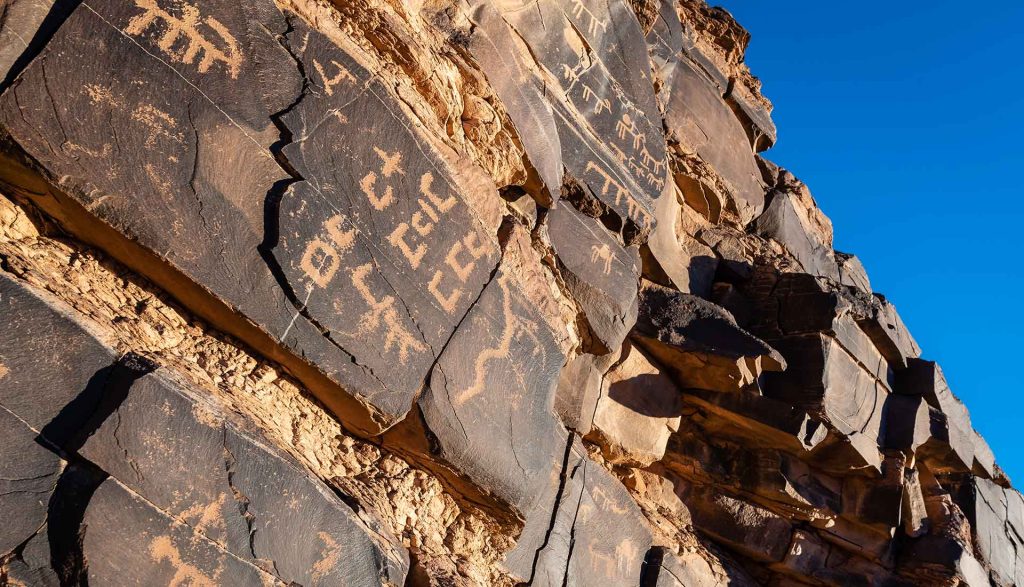
Tifinagh inscriptions — Photo credit : ABDELLAH AZIZI, from the article by Ahmed Skounti (French Language).
Tifinagh: An Archive in Stone
The Tifinagh alphabet is undoubtedly one of the most powerful symbols of Sahelian sovereignty. Unlike alphabets imposed by successive colonial or religious waves, Tifinagh is an endogenous script that marks the territory. It is found engraved on the rock faces of the Adrar des Ifoghas or the Aïr, transforming the landscape into an open-air archive.
This writing is not just a vestige of the past; it is a code of recognition. It allows the Tuareg link to signal their presence, transit rights, and memory on a space that the modern State desperately tries to make “legible” through bureaucracy. By marking the stone, the Tuareg decolonizes the space and reminds us that legitimacy belongs to those who know the names of the places and their deep history9.
Kel Tamasheq: A Linguistic Bridge
Defining oneself as “Kel Tamasheq” (those who speak Tamasheq) places language at the center of identity. But this language is far from an isolate. For centuries, it has acted as a lingua franca of arid zones, absorbing and redistributing concepts from the Mediterranean North and the Sudano-Sahelian South.
The Tuareg, as a link, ensures the translation of needs. In a camp, mastery of Tamasheq is often accompanied by a practical knowledge of Hausa, Arabic, or Songhai. This natural polyglossia makes the nomad the diplomat of the Sahel. This ability to facilitate dialogue between distinct cultural universes is the engine of a true “Afrotopia”: a future where African intellectual sovereignty draws from its own roots to invent a modernity that is not a copy of the West10.
IV: Reticular Resilience vs. The Straight Line
The drama of the contemporary Sahel lies in the collision between two incompatible geometries: the straight line of the Nation-State, inherited from colonial partitions, and the curve of the nomadic network. For the Tuareg, the border is not a wall; it is a membrane. It must remain porous to allow for life and the maintenance of transboundary ecosystems.
Rejecting the Closed Perimeter
Tuareg political organization has always favored an acephalous or confederated structure, much closer to the architecture of a decentralized network than to a Jacobin administration. This reticular resilience allows the “link-people” to survive where rigid structures collapse. If one axis is blocked by a crisis, the network generates another instantaneously.
This ubiquity—the ability to be everywhere without being locked in anywhere—makes the Tuareg actors of a de facto sovereignty. They do not wait for the validation of official maps to exist; they exist through motion and the persistence of their historical trajectories.
Conclusion: Toward a Sovereignty of Flows
The history of the Sahel is not one of suffered fragmentation, but of practiced integration. By observing the intersecting trajectories of the Hausa and the Tuareg, one thing becomes clear: the region does not lack structures; it overflows with links. If the Hausa constitute the economic pivot, the engine capable of transforming every town into a nerve center, the Tuareg are the transmission, the essential link that allows energy to circulate across thousands of kilometers.
This symbiosis forms what we call The Foundation (Le Socle). It is an anthropological foundation that has outlived colonial empires and continues to defy the rigidity of modern nation-states. For the Sahel to regain its full sovereignty, it must not seek to copy imported governance models; instead, it must sanctify these networks of mobility. Sovereignty will be defended by language, by the credit of trust (Amana), and by the unique ability to turn every interstice into an opportunity11.
To go further:
- Explore our analysis of the Southern economic engine in our article dedicated to the Hausa Invisible Empire.
- Follow our field reports and in-depth analysis in our Deciphering section.
Footnotes / references
- Michel Foucher, Frontières d’Afrique. A fundamental work on rethinking borders as resources and living spaces rather than mere barriers. ↩︎
- Camille Lefebvre, Frontières de sable, l’État au Niger. An analysis of how populations absorbed or ignored colonial boundaries. ↩︎
- Michel Foucher, Frontières d’Afrique : Pour en finir avec les 20 %. On the transformation of borders into strategic resources by indigenous peoples. ↩︎
- Murray Last, The Sokoto Caliphate. Essential for understanding historical legitimacy and persistent political order beneath modern structures. ↩︎
- Mahdi Adamu, The Hausa Factor in West African History. ↩︎
- Emmanuel Grégoire, Les commerçants haoussa du Niger. On the Amana mecanismes and les sahelian business networks. ↩︎
- Kate Meagher, Identity Economics. On ethnic identity as an invisible and highly efficient economic infrastructure.ethnique comme infrastructure économique invisible et efficace. ↩︎
- George Peter Murdock, Ethnographic Atlas. The technical tool used to dissect matrimonial and family structures. ↩︎
- Achille Mbembe, Out of the Dark Night. On the necessity of decolonizing space and minds to regain true sovereignty. ↩︎
- Felwine Sarr, Afrotopie. A manifesto inviting us to draw from Sahelian traditions to invent an autonomous future. ↩︎
- Achille Mbembe, Out of the Dark Night. A final invitation to rethink the African community of destiny beyond inherited structures, by relying on the reality of human and cultural circulation. ↩︎
Plus de Trajectoires…